Ethereum gas in November 2026: why fees are fractions of a cent, and what still makes them spike
One week of on-chain data (51,200 blocks): median base fee 0.137 gwei, blocks 50.6% full, blob fees near the floor, plus a 22.45 gwei spike on 20 November. How base fee, tips and blob fees work, and how to pay less.

If you have not sent an Ethereum mainnet transaction in a while, the numbers may surprise you. For most of the past week, a plain ETH transfer cost well under one cent. Yet on the afternoon of 20 November the same transfer briefly cost about 80 cents. This article explains, with fresh on-chain data, how Ethereum gas prices are formed today, why they are so low, and what can still make them jump.
The data: one week of Ethereum gas
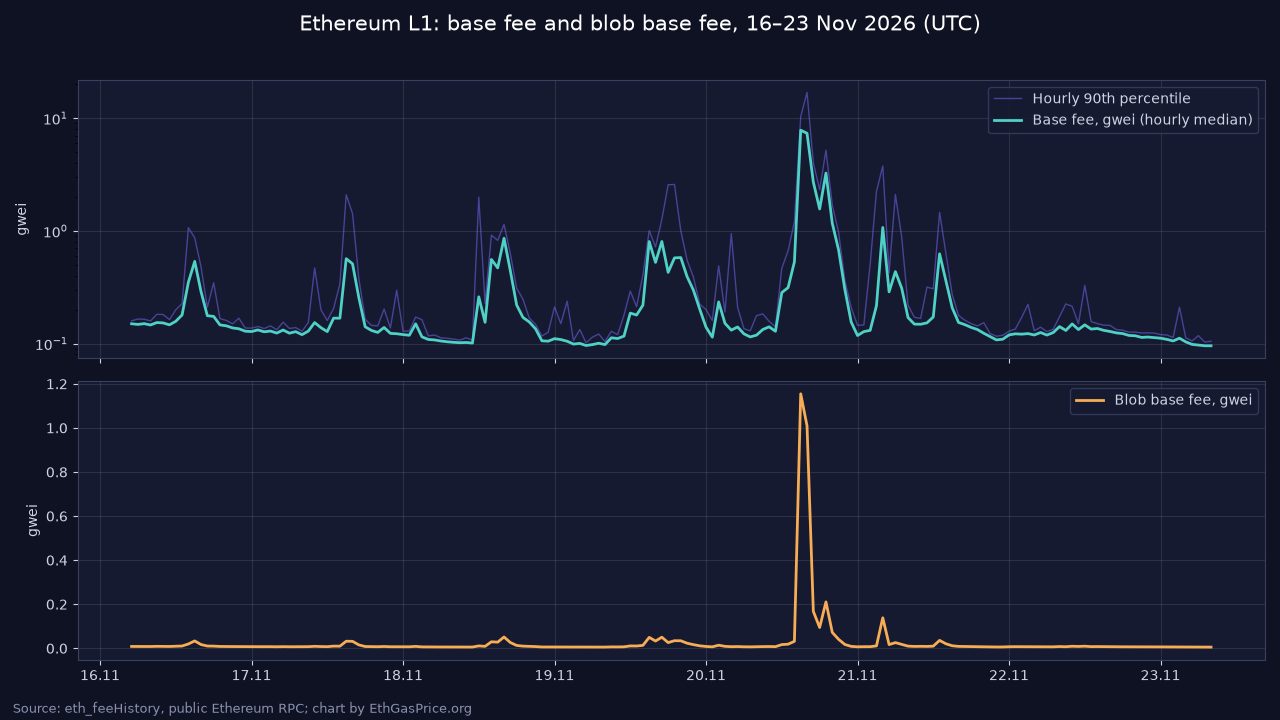
We pulled fee history for 51,200 consecutive blocks (blocks 26,425,591 to 26,476,790, 16 November 05:48 UTC to 23 November 08:58 UTC) using the standard eth_feeHistory call on a public Ethereum RPC node. Here is what it shows:
- Median base fee: 0.137 gwei. Half of all blocks were cheaper, half more expensive.
- Range: from a low of 0.072 gwei to a high of 22.45 gwei in block 26,457,386 (20 November, 16:05 UTC). The 90th percentile was 0.594 gwei.
- Expensive blocks were rare: only 2,921 blocks (5.7%) had a base fee above 1 gwei, and most of them came in one stretch on 20 November between roughly 15:00 and 21:00 UTC.
- Typical priority fee (tip): the median of the per-block 50th-percentile tip was 0.0196 gwei.
- Block usage: blocks were 50.6% full on average against a 60 million gas limit. That sits almost exactly on the protocol's target.
- Blob fees: the median blob base fee was 0.008 gwei per unit of blob gas, peaking at 3.67 gwei during the same 20 November rush. On average, blocks used 32% of the maximum blob space.
What that costs in dollars
A fee in ETH is simply gas used × (base fee + tip). With ETH at $1,722.68 (CoinGecko, 23 November 09:04 UTC), the week looks like this:
- ETH transfer (21,000 gas): about $0.006 at the median, $0.02 at the 90th percentile, and $0.81 at the 20 November peak.
- Token swap (about 150,000 gas, a rough figure; real swaps vary by route): about $0.04 at the median, $0.16 at the 90th percentile, and $5.80 at the peak.
- One blob for a rollup (131,072 blob gas): about $0.002 at the median blob fee and $0.83 at the peak.
The takeaway: on a normal day mainnet is cheap enough for almost anything, but the gap between a quiet hour and a busy one can be more than 100 times.
How the price is set: three moving parts
1. The base fee (EIP-1559)
Since EIP-1559, every block has a protocol-set base fee that is burned rather than paid to validators. The protocol targets blocks that are half full. If a block uses more gas than the target, the next base fee rises; if it uses less, it falls. The maximum step is 12.5% per block, roughly every 12 seconds.
That rule explains both halves of the week. When demand hovers around the target, as it did most days with 50.6% average usage, the base fee drifts gently near its floor. When demand jumps, a run of full blocks compounds 12.5% at a time: about 40 full blocks in a row (eight minutes) is enough to raise the fee more than a hundredfold. That is how 0.14 gwei turns into 22 gwei in one afternoon.
2. The priority fee (tip)
The tip goes to the validator and buys ordering inside a block. When blocks are not full, tips barely matter, which is why the typical tip this week was only about 0.02 gwei. Tips rise during rushes, when traders, liquidators and arbitrage bots compete for the same block. Wallets estimate tips for you, but a very low manual tip can leave a transaction waiting when the network gets busy.
3. The blob fee (EIP-4844)
EIP-4844 created a separate market for "blobs", large chunks of data that rollups post to Ethereum. Blob gas has its own base fee with the same logic of rising when demand exceeds a target. Each blob carries 131,072 units of blob gas. Because blob space was only about a third used this week, the blob fee stayed near its floor most of the time. This is the main reason L2 fees on networks like Base, Arbitrum or OP Mainnet stay at fractions of a cent.
Why gas is so cheap right now
- Capacity. At 60 million gas per block, today's mainnet has a 30 million gas target, so blocks can absorb a lot of ordinary activity before the base fee moves.
- Activity moved to L2s. Swaps, games and payments that once crowded L1 now mostly run on rollups, which reach L1 through blobs.
- A quiet market. Calm markets mean fewer liquidations and less arbitrage, and therefore fewer bidding wars for block space.
What makes it spike
The 20 November burst shows the pattern. Within a few hours the base fee peaked at more than 160 times the weekly median, and the blob fee rose with it. Bursts like this usually come from sharp price moves, which trigger DEX trading, arbitrage and lending liquidations. They can also come from popular token launches or mints, or from airdrop claims. Our data shows when fees rose, not who caused them, so treat these as the usual suspects rather than a diagnosis of that day.
Practical tips
- Check before you send. If the base fee is far above the recent median, waiting even an hour often pays off, because base fees fall as fast as they rise.
- Set a sensible max fee. Your max fee caps what you pay. Anything above the actual base fee plus tip is refunded.
- Use L2s for small, frequent actions. With blob fees near the floor, rollup transactions remain the cheapest way to use Ethereum.
- Batch L1 jobs. Contract deployments, bridge withdrawals and treasury moves are best done during quiet hours.
Outlook: what could change the picture
The biggest change on the horizon is the Glamsterdam upgrade, which aims to raise the block gas limit from 60M to 200M and is now expected in early 2027. A higher target would make spikes like 20 November flatter and keep the base fee near its floor at today's demand, while state creation becomes more expensive in gas terms. Until then, expect what this week showed: cheap on average, spiky under stress. EthGasPrice.org will keep tracking both.