Ethereum's data floor, explained: why EIP-8279 now meters validator deposits too
A 22 November patch to EIP-8279 charges a 12,288-gas floor for each 192-byte deposit request, closing a loophole that could let blocks grow past the planned byte cap. Who pays more under the Hegotá data-floor EIPs, and what it means for gas fees.

On 22 November, Toni Wahrstätter, who wrote EIP-8279, opened pull request #12686 to extend the draft, which prices the bytes a transaction adds to a block. The patch closes a small but real loophole: validator deposits could be used to stuff blocks with data that the gas floor does not see. It is a one-line idea with a long backstory, and it says a lot about how Ethereum plans to raise the gas limit without letting blocks grow dangerously large.
The problem: gas limits blocks, not bytes
Gas measures computation, but nodes also have to download, store and propagate every block. The network has to be able to handle the largest block an attacker can build, not the average one. If some kind of data is cheap in gas, an attacker can pack a block with it and slow every node down.
Ethereum's answer is the floor. Since EIP-7623, a transaction pays the higher of two numbers: its normal gas usage, or a minimum based on how many bytes it carries. Ordinary transactions never notice, because their execution already costs more than the floor. Only data-heavy transactions that do little computation get pushed up to it.
That floor is being built out step by step:
- EIP-7976 and EIP-7981, both scheduled for Glamsterdam, raise the calldata floor to a uniform 64 gas per byte and extend it to access lists.
- EIP-8131 folds everything a user writes into a transaction into one rule at 64 gas per byte: calldata, access lists, EIP-7702 authorizations and the 32-byte hashes that point to blobs.
- EIP-8279 covers the bytes that appear only during execution, in the new Block-Level Access List (EIP-7928) that Glamsterdam introduces.
Why the Block Access List needed its own floor
The Block Access List records every account and storage slot a block touches, so clients can process transactions in parallel. That list travels with the block, and opcodes fill it at runtime. The cheapest way to grow it is a cold SLOAD: 32 bytes of list data for 2,100 gas.
According to the EIP-8279 specification, an attacker who mixes calldata with cold SLOADs could fit about 1.546 MiB into a 60M-gas block, against a 0.894 MiB target. EIP-8279 adds a per-transaction byte counter: each first account touch adds 20 bytes, each first storage key 32 bytes, deployed code its full length, and so on, all priced at the same 64 gas per byte. Combined with EIP-8131, the worst case is capped at block gas limit / 64, plus a small fixed overhead per transaction. That is about a 42% cut in worst-case payload with no change to the gas limit.
What the new patch adds: deposit requests
Since EIP-6110, the execution layer turns each validator deposit into a 192-byte request that rides in the block. The PR notes that "Gloas made DepositRequests an unbounded list, and the EL never capped it. Gas is the only limit." Neither EIP-8131 nor EIP-8279 counted those 192 bytes.
Once EIP-8279 shuts the cold-SLOAD route, that becomes the next bypass. A relay contract can call the deposit contract in a loop at about 26,000 gas per deposit, which fits under the zero-byte calldata floor. The PR estimates that this pushes the block payload to about 1.44 × gas limit / 64 instead of about 1.15×.
The fix is a single extra trigger. When the deposit contract emits a log with the deposit event topic, the same condition EIP-6110 uses to create a request, the meter adds 192 bytes, or 12,288 floor gas, before the log is written. A normal deposit already spends about 26,000 gas on execution, well above that floor, so stakers pay nothing extra. The cost lands on client teams, who have to implement and test one more check.
Where it stands
EIP-8279 is a Draft and the deposit patch is still an open pull request. EIP-8131 and EIP-8279 are both Considered for Inclusion in Hegotá, the fork after Glamsterdam, according to the Hegotá meta EIP-8081. So far only FOCIL and Frame Transactions are scheduled for it. "Considered" means client teams are evaluating them; it is not a commitment.
Who would pay more
The EIP's authors measured the effect on real mainnet traffic over 90 days (22 August to 19 November 2026, 168,284,788 transactions):
- Plain ETH transfers stay at 21,000 gas.
- EIP-7702 transactions are hit hardest. Each authorization carries a combined floor of 11,776 gas. The static part of the rule raises costs for 378,522 transactions (0.22%), all of them type-4, adding 0.03% to total gas on top of EIP-8131.
- Everything else: in a 400-block traced sample, with execution costs adjusted for Glamsterdam's EIP-8038, runtime metering raised the cost of 3.7% of transactions and added 0.83% to total gas. A plain ERC-20 transfer meters 128 bytes, or 8,192 floor gas.
- Rollup batch transactions pay 2,048 floor gas per blob hash (32 bytes × 64) under the shared EIP-8131 formula. The blob fee itself is priced in a separate market and does not change.
Gas price analytics: what this means for fees
We pulled eth_feeHistory for the last 7,200 mainnet blocks (26,470,973 to 26,478,172, 22 November 13:32 UTC to 23 November 13:36 UTC) from a public Ethereum RPC:
- L1 base fee: median 0.114 gwei, mean 0.121 gwei, peak 0.352 gwei. It climbed towards 0.19 gwei in the last two hours of the window.
- Priority fee: the median 50th-percentile tip was about 0.0096 gwei.
- Block usage: 50.7% of the 60M gas limit on average, right at the EIP-1559 target.
- Blob base fee: median 6.6 Mwei (0.0066 gwei), range 4.3 to 21.7 Mwei. Blob usage averaged 32% of maximum capacity, and 26% of blocks carried no blobs.
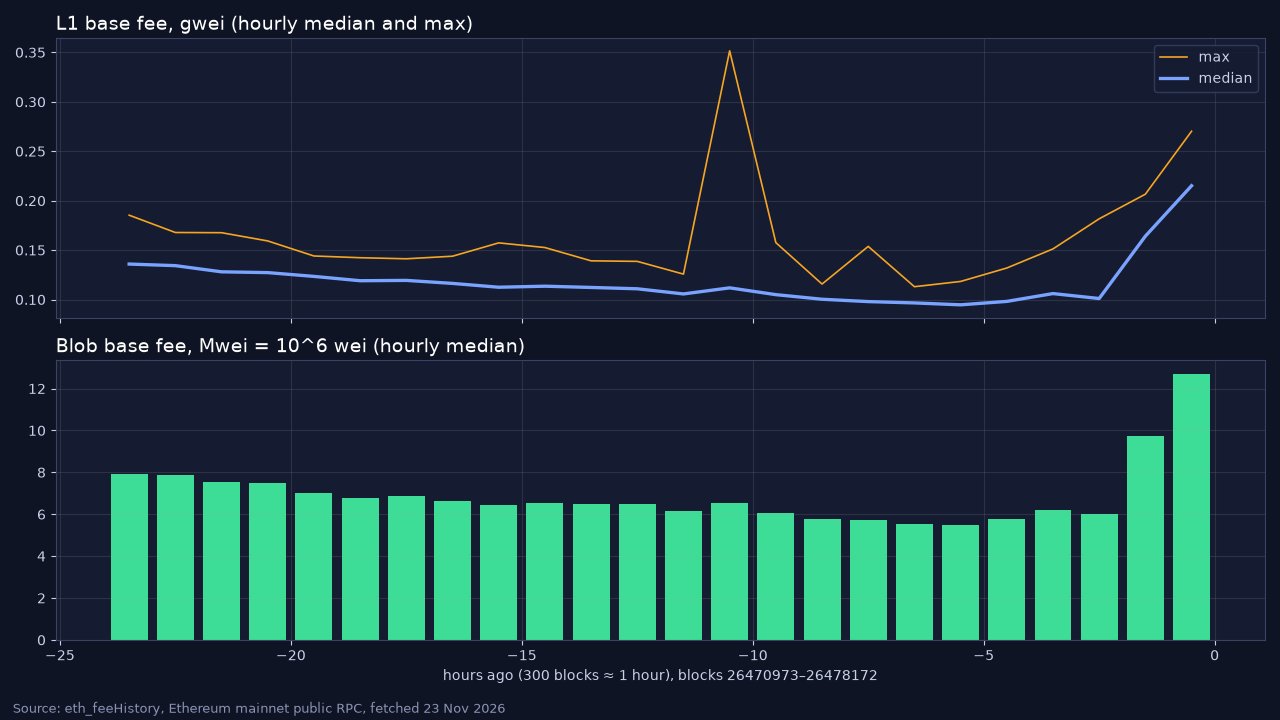
At the median base fee plus tip and ETH at $1,719.69 (CoinGecko), the numbers in this proposal are tiny in dollar terms:
- The 12,288 gas deposit floor would be worth about $0.0026 if it ever bound. For a normal deposit it doesn't.
- The 2,048 gas floor per blob hash is about $0.0004. A rollup batch with six blobs adds roughly $0.0026 at most, and only when the batch transaction is floor-bound.
- For comparison, a simple 21,000 gas transfer costs about $0.0045.
Short term: no effect. Nothing here is live, and Glamsterdam itself is not expected on mainnet before early 2027.
Once Hegotá ships, if these EIPs make it in: floor-bound transactions use slightly more block gas, about 0.8% in the authors' sample, which is a marginal upward push on the base fee when blocks sit at target. The bigger effect points the other way. A provable byte cap is what lets core developers keep raising the gas limit safely, and a higher limit with the same demand pushes the base fee down. Blob fees and L2 user fees are not directly affected.
The deposit patch is a reminder of how Ethereum scales: each new source of block data gets priced before it can be abused, so the gas limit can keep rising without putting node operators at risk.